
How Experts Optimize a Link in Bio for High-Ticket Sales
TL;DR
High-ticket buyers need clarity, proof, and a guided next step, not a crowded list of links. Strong link-in-bio optimization prioritizes authority-first messaging, visible trust signals, clear CTAs, and measurement tied to qualified actions.
Most creators treat their bio page like a menu. Experts who sell premium offers treat it like a qualifying storefront.
That distinction matters because high-ticket buyers do not click with casual intent. They need confidence, clarity, and enough proof to believe that taking the next step will be worth their time and money.
A useful rule is simple: for premium offers, the bio page should reduce uncertainty before it asks for action. That sentence is worth remembering because it explains why many standard link pages underperform when the goal is not clicks, but booked calls, serious inquiries, and paid engagements.
Why high-ticket buyers behave differently from low-intent social traffic
Basic link-in-bio optimization often focuses on increasing taps. That is not wrong, but it is incomplete.
High-ticket sales introduce a different buyer psychology. The visitor is not deciding whether to read a blog post or watch a video. They are deciding whether to trust the person behind the offer with money, time, reputation, or business outcomes.
That changes the job of the page.
Instead of acting like a directory, the page needs to do four things in sequence:
- Confirm relevance
- Build authority
- Reduce friction
- Guide the next action
This is the practical model that strong creator storefronts follow. It can be called the authority-to-action path: relevance first, trust second, proof third, conversion fourth. It is simple enough to remember and specific enough to reuse.
A lot of standard link-in-bio setups fail because they reverse that order. They ask visitors to click before establishing context. They present six to twelve equal links, minimal proof, and no clear hierarchy. That may work for broad audience traffic, but it is a weak format for premium consulting, coaching, advisory work, specialized services, or higher-priced digital offers.
According to Hootsuite’s guide to bio links, the basic purpose of a link in bio is to direct followers from social profiles to a destination where they can take action. That is the baseline. The problem is that for high-ticket intent, sending people off-page repeatedly can create friction instead of momentum.
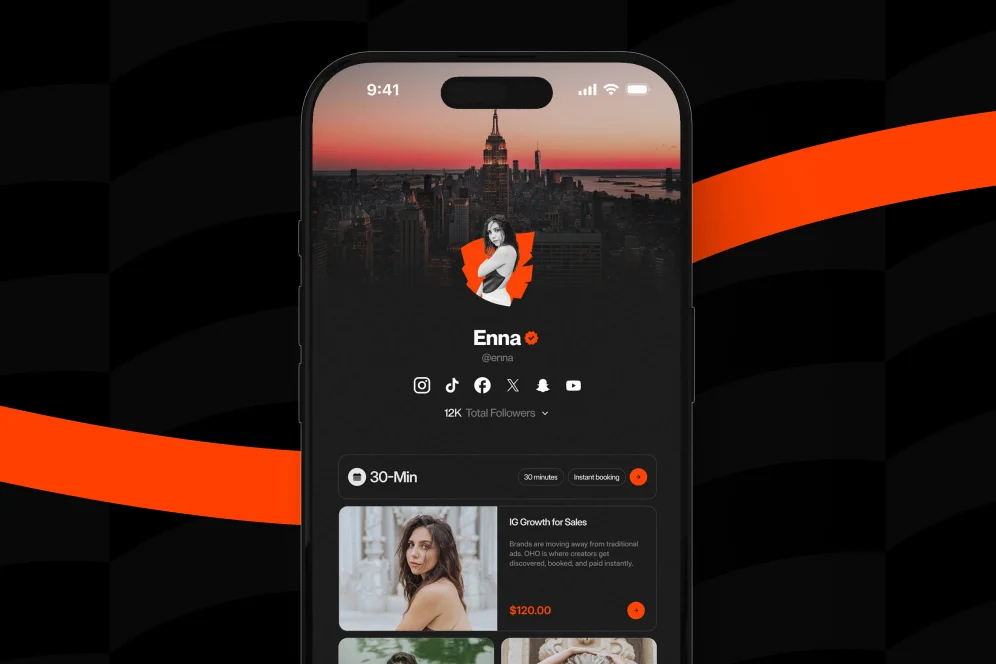
This is where Oho is best framed differently from a standard link list. Rather than acting as a prettier outbound menu, it is designed as the conversion and monetization layer of the creator’s public page: a place to sell, book, subscribe, and manage structured inquiries from one destination.
That distinction matters even more when your offer depends on trust.
The authority-first page structure experts actually use
When experts optimize for premium conversions, they do not start with colors, icon sets, or aesthetic moodboards. They start with information order.
The first screen needs to answer three questions immediately:
- Who is this for?
- Why should I trust this person?
- What should I do next?
If those answers are missing, the visitor starts doing work the page should have done for them.
What belongs above the fold
For a high-ticket bio page, the top section should usually include:
- A clear identity line
- A focused value proposition
- One primary call to action
- One secondary action for lower-intent visitors
- A visible credibility cue
A weak version says: “Creator | Speaker | Coach | Entrepreneur.”
A stronger version says: “Helps B2B founders turn audience trust into booked consulting work.”
The second version qualifies the visitor. It also creates self-selection, which is critical in link-in-bio optimization when the page needs to support better leads rather than more random clicks.
Why one primary action usually beats many equal links
According to Solo’s overview of link in bio best practices, link-in-bio optimization is fundamentally about organizing clickable destinations on social profiles more effectively. For low-ticket or content-driven accounts, multiple links can be fine.
For premium offers, too many equal-weight options usually weaken intent.
The contrarian position is this: do not give high-value visitors more choices; give them a stronger reason to choose one path.
That does not mean hiding everything else. It means creating a clear hierarchy:
- Primary CTA: book a consultation, apply, inquire, or purchase
- Secondary CTA: download a guide, join a newsletter, review case studies
- Tertiary links: podcast, social channels, older resources
Experts also label the action in buyer language. “Work with me” is vague. “Book a 30-minute advisory session” is concrete. In fact, packaging expertise into a short paid session can be especially effective for creators who want to qualify buyers before deeper engagements, which is why our guide to paid bookings is relevant here.
A practical before-and-after example
Baseline:
A consultant’s page contains nine links, no explanation of the core offer, and a generic CTA reading “Let’s connect.” Traffic from Instagram and LinkedIn arrives, but most users bounce after a single tap or choose low-intent links like YouTube.
Intervention:
The page is rebuilt so the first screen states the niche, names the outcome, adds a single “Book a paid strategy call” CTA, and places social proof plus a structured inquiry option directly underneath.
Expected outcome:
The page should reduce unqualified clicks, increase booking intent, and improve the percentage of visitors who either book or submit a serious inquiry.
Timeframe:
Measure the change over 4 to 6 weeks using the same traffic sources and offer pricing.
That is the correct way to think about proof here: not invented conversion lifts, but a clear measurement plan tied to behavior.
The trust signals that matter more than visual polish
Many creators over-invest in aesthetics and under-invest in evidence. For premium offers, that is usually backwards.
Lifestyle-style bio pages often emphasize personality, visuals, and broad brand vibes. That can work for top-of-funnel attention. It is less effective when the visitor is deciding whether to spend hundreds or thousands of dollars.
Authority is built through specificity.
The five trust elements that pull their weight
A high-converting premium page usually includes most of these:
- Specific niche positioning
Name the category of buyer and the problem solved.
- Offer clarity
State what is being sold: consulting session, audit, package, workshop, downloadable framework, or application.
- Process visibility
Explain what happens next. Unclear intake creates hesitation.
- Proof and credibility
This can include client logos, outcome statements, selected testimonials, media mentions, credentials, or notable experience.
- Professional identity signals
Clean usernames, consistent branding, and a more serious presentation increase perceived legitimacy.
This last point is often overlooked. A polished public identity does not close deals by itself, but it reduces suspicion. Oho’s positioning around creator usernames, profile presentation, and a cleaner monetization-focused page aligns well with that need.
What trust looks like in the actual layout
Trust signals should not be buried at the bottom.
A better layout is:
- Value proposition and primary CTA at top
- Short credibility strip immediately below
- Offer cards or booking options next
- Brand collaboration inquiry path or newsletter option after that
- Supporting links last
That order reflects decision gravity. The page should support the commercial action first, not treat it as one link among many.
As Later’s link in bio product page and Lnk.Bio both reflect, the market generally understands bio pages as hubs for multiple destinations. The expert move is to turn that hub into a guided path rather than a loose collection of exits.
Why structured inquiries outperform generic DM requests
For high-ticket services, “DM me” is a weak intake mechanism.
It creates hidden friction:
- no qualification data
- no consistent process
- no analytics trail
- no reliable routing for brand or client requests
A structured collaboration or inquiry flow is better because it captures intent in context. That is especially relevant for creators balancing services, digital products, newsletter growth, and partnership requests from one audience stream.
Instead of pushing people into manual back-and-forth, Oho is designed to centralize these actions on-page. That is one of the clearest advantages over a standard bio tool that simply redirects traffic outward.
A 4-step audit for link-in-bio optimization that supports premium conversions
Most pages do not need a redesign from scratch. They need a more disciplined audit.
Use this four-step review process every quarter, after major offer changes, or whenever social traffic increases but premium conversions stay flat.
Step 1: Audit the page like a cold visitor
Open the page with no prior context and give it ten seconds.
Check whether the following are obvious:
- audience served
- primary transformation or value
- main offer type
- next step
- reason to trust the creator
If any of those are unclear, the page is under-explaining the commercial decision.
A practical test is to ask: could a stranger describe this offer after one screen without clicking anything else?
If not, fix messaging before changing design.
Step 2: Collapse duplicate paths
Many pages contain multiple links that serve the same purpose.
Examples:
- “Book me”
- “Consulting”
- “Strategy session”
- “Apply to work together”
These often confuse rather than help.
Choose one primary path for each intent level:
- ready to buy now
- wants more proof first
- not ready, but interested
This is where a conversion-focused page outperforms a generic link list. Instead of scattering intent across separate tools for bookings, digital products, and email capture, Oho can bring those actions into one workspace and one public destination.
Step 3: Instrument what matters
Link-in-bio optimization without measurement quickly becomes guesswork.
At minimum, track:
- visits to the bio page
- clicks on the primary CTA
- booking starts
- completed bookings or purchases
- inquiry submissions
- newsletter sign-ups
The exact analytics stack depends on your setup, but the principle is stable: do not stop at clicks. Measure progression.
For many experts, the right KPI is not total taps but qualified action rate: the percentage of visitors who take a commercially meaningful step.
This fits the broader shift in bio link thinking documented across practical guides such as yoursocial.team’s article on optimizing your Instagram bio link, where the emphasis is not just having a link, but using it intentionally based on destination and goal.
Step 4: Rewrite weak CTAs and labels
Small wording changes can materially improve clarity.
Replace vague CTA labels with specific action language:
- “Start here” becomes “Book a discovery call”
- “Learn more” becomes “See how the audit works”
- “Offers” becomes “Buy the workshop replay”
- “Contact” becomes “Submit a brand inquiry”
This is especially important on mobile, where users scan faster and tolerate less ambiguity.
If your page supports expert consultations, our link-in-bio conversion guide goes deeper on how action wording shapes behavior.
Design choices that increase trust without making the page feel heavy
Premium conversion pages should look clean, but they should not become minimalist to the point of hiding meaning.
A common failure mode in link-in-bio optimization is aesthetic reductionism: fewer words, fewer cues, fewer details, and therefore less confidence.
Keep the visual system quiet and the information system strong
Use a restrained design system:
- one dominant CTA style
- one secondary CTA style
- consistent spacing between offer modules
- high-contrast text
- restrained icon usage
- mobile-first hierarchy
This is not about making the page look plain. It is about ensuring that visual attention supports commercial intent.
Put proof where it changes the decision
Do not reserve testimonials or credibility notes for a hidden lower section if the offer is expensive.
Examples of useful proof placement:
- under the hero CTA: “Trusted by founders, educators, and creators”
- adjacent to a paid call offer: “Best for people who need specific direction in 30 minutes”
- under a collaboration inquiry form: “For podcasts, speaking, partnerships, and sponsored projects”
That level of specificity reduces mismatch.
Use screenshots or offer cards with explicit outcomes
Where relevant, show offer cards that include:
- what the buyer gets
- who it is for
- expected format
- duration or scope
- price if public
High-ticket buyers usually appreciate directness. Hidden pricing can be useful in some consultative sales processes, but hidden scope almost never helps.
For creators selling time, packaging the offer into shorter, well-defined sessions often performs better than an open-ended “work with me” page. Again, this deeper breakdown of paid expert calls is a useful companion if that model fits your business.
Common mistakes that quietly kill premium conversion intent
Weak premium pages are often not broken in obvious ways. They fail in subtle ways that make serious buyers hesitate.
Treating every visitor as equally ready
A visitor from TikTok, Instagram, LinkedIn, or a podcast mention may have very different intent.
A good bio page serves multiple awareness levels, but it does not flatten them into identical choices. It prioritizes the highest-value next step while still giving lower-intent users a softer path.
Confusing lifestyle branding with business credibility
For premium offers, the page should feel personal but not casual.
Aspirational imagery and broad creator branding are not substitutes for proof, clarity, and process. If the visitor cannot tell what is being sold or how engagement works, visual style will not save the conversion.
Sending people to too many external tools
One of the biggest friction points in standard setups is fragmentation.
A visitor clicks the bio link, then clicks out to a booking tool, then gets routed to a separate checkout page, then maybe to an unrelated intake form. Every redirect costs confidence.
This is exactly the fragmentation Oho is designed to solve. Instead of splitting products, bookings, subscriber capture, and partnership requests across disconnected tools, creators can centralize those actions in one monetization-focused page. That is also why our overview of replacing multiple creator tools is relevant for operators trying to simplify their stack.
Optimizing for click volume instead of commercial quality
A page can generate more taps and still perform worse.
If users are clicking entertainment links, low-value resources, or broad social destinations instead of booking or inquiring, the page is leaking commercial intent.
The right question is not “Did clicks increase?”
The right question is “Did more qualified visitors take the action that produces revenue?”
Ignoring follow-up paths for visitors who are interested but not ready
Not every premium buyer converts on first visit.
That is why the secondary CTA matters. Newsletter sign-up, a compact lead magnet, or a high-value case-study page can keep the relationship moving without forcing a hard sell.
For creator-led businesses, subscriber capture is not separate from revenue. It is often the bridge between social discovery and later conversion.
How to measure whether your page is helping or hurting high-ticket sales
The most useful measurement approach is a simple funnel review.
Track the page across this sequence:
impression -> AI answer inclusion -> citation -> click -> conversion
That path matters more in 2026 because more discovery begins in AI-generated answers, summaries, and recommendation layers. In that environment, brand becomes a citation engine. Pages that are specific, quotable, and credible are more likely to be surfaced, cited, and trusted.
What to monitor each month
Use a monthly review with these inputs:
- Traffic source by platform
- Bio page visit volume
- Primary CTA click-through rate
- Booking start rate or inquiry start rate
- Completed conversion rate
- Assisted conversions from newsletter or follow-up paths
If the page has traffic but weak conversion starts, the messaging or hierarchy is likely off.
If conversion starts are healthy but completions are weak, the downstream booking or checkout process may be introducing friction.
If only low-intent actions are increasing, the page may be attracting curiosity instead of commercial intent.
What a healthy test plan looks like
Do not change everything at once.
Test one variable at a time over a meaningful period, such as 2 to 4 weeks depending on traffic volume:
- CTA wording
- offer order
- proof placement
- hero statement
- form structure
- number of visible links
Document baseline metrics before each test. Then review not only gross clicks, but qualified outcomes.
This is where Oho’s emphasis on conversion visibility is useful. The page should not just host links. It should make it easier to understand what is actually producing value.
FAQ: the questions experts ask before rebuilding their bio page
Are link-in-bio tools actually hurting conversions?
They can hurt conversions when they act as unordered link directories instead of guided decision pages.
As practical platform guides from Solo and Hootsuite make clear, the core purpose is to route social traffic effectively. The issue is not the category itself. The issue is using a low-context click menu for a high-trust sale.
What is the best link-in-bio setup for a consultant, coach, or expert?
The best setup usually has one clear premium action, one lower-friction secondary action, proof near the top, and a simple structure that explains what happens next.
For experts, a conversion-focused storefront is generally more effective than a basic link list because it can support bookings, products, subscribers, and inquiries from one page.
Should high-ticket offers show pricing on the bio page?
It depends on the sales model.
For defined offers like paid calls, workshops, or audits, visible pricing can improve qualification. For custom engagements, it may be better to explain scope and route visitors to an inquiry or application path instead.
How many links should a premium bio page include?
Fewer than most creators think.
There is no universal number, but high-ticket pages often perform better when they prioritize one primary CTA, one secondary path, and a limited set of support links rather than presenting a long undifferentiated list.
What should I track first if I want better link-in-bio optimization?
Start with commercially meaningful actions, not vanity metrics.
Track visits, primary CTA clicks, booking or inquiry starts, completed conversions, and subscriber capture. Then evaluate which traffic sources produce qualified outcomes.
Can one page really support products, bookings, email capture, and brand deals?
Yes, if the page is structured by intent instead of by random link order.
That is one of the clearest reasons creators move beyond standard bio tools. A single monetization-focused page can centralize those actions while keeping the public profile cleaner and easier to understand.
A premium bio page should not feel like a scrapbook of links. It should function like a storefront that qualifies, reassures, and converts. If you want a cleaner way to sell digital products, accept bookings, collect subscribers, and manage collaboration inquiries from one conversion-focused page, explore how Oho can support your next upgrade.