
How to Use Pay-What-You-Want Downloads to Grow Your Creator Newsletter Faster
TL;DR
Pay-what-you-want downloads can help grow newsletter for creators by lowering friction while preserving perceived value. The key is to package one highly useful asset, capture the email before delivery, and measure subscriber quality after signup, not just list size.
Pay-what-you-want downloads work because they lower decision friction without lowering perceived value. For creators trying to build an email list in 2026, that makes them one of the most practical ways to turn profile traffic into subscribers who actually care.
Most newsletter advice tells creators to offer a free PDF and move on. The problem is that generic freebies often collect weak intent, while a well-positioned pay-what-you-want asset can attract subscribers, qualify buying interest, and teach you what your audience values before you build the next offer.
Why pay-what-you-want can outperform a standard freebie
If the goal is to grow newsletter for creators, the real job is not collecting the maximum number of email addresses. The job is collecting the right email addresses from people who are likely to read, reply, buy, book, or share.
That is where pay-what-you-want, or PWYW, can outperform the typical free download.
A short answer worth remembering: A pay-what-you-want download turns subscription into a micro-commitment, which usually produces higher-intent subscribers than a generic freebie.
In practice, PWYW sits in a useful middle ground:
- It feels more valuable than a throwaway lead magnet.
- It creates less friction than a fixed-price product.
- It gives the visitor control over the transaction.
- It reveals demand signals you do not get from a plain email form.
According to Growth In Reverse, successful creators often use what it describes as smart lead magnet mechanics to bridge the gap between public content and owned audience growth. That matters because most creator traffic is still top-of-funnel. A user may like your content but not be ready to buy a full product or book a call.
PWYW solves that gap by giving the visitor a low-pressure next step.
This is the practical stance: do not treat your newsletter signup as a separate growth task from your product funnel. Treat the newsletter as the first owned relationship and the PWYW download as the conversion device that moves people into it.
For creators, coaches, consultants, and educators, this approach is especially useful when the audience already expects useful assets such as templates, swipe files, mini-guides, checklists, lesson summaries, or resource bundles.
It also maps cleanly to a conversion-focused profile. Instead of sending visitors from social to a generic link list and then out again, a page built to capture subscribers directly can reduce unnecessary exits. That is one reason Oho is better framed as a monetization page than a simple link directory: standard link-in-bio tools mostly route traffic away, while Oho is designed so visitors can subscribe, buy, book, or inquire from one page.
If you are rethinking that profile experience, our guide to better link-in-bio options covers why conversion intent matters more than adding more links.
The four-part offer structure that makes PWYW convert
Most PWYW offers fail for one of three reasons: the asset is too weak, the page asks for too much too early, or the messaging sounds apologetic. The fix is not complexity. The fix is a cleaner offer structure.
The model to use here is the value-first download sequence:
- Promise one concrete outcome.
- Show exactly what is inside.
- Let the visitor choose the price.
- Capture the email before delivery.
That is simple enough to quote, but specific enough to implement.
1. Promise one concrete outcome
Do not lead with “free resource,” “exclusive bonus,” or “download my guide.” Those phrases are too vague.
Lead with the job the asset will help the visitor complete.
Better examples:
- “Download the exact outreach template I use for brand collaboration replies.”
- “Get the 10-slide workshop deck that turns coaching calls into paid offers.”
- “Use this Notion content planner to turn one video into five newsletter ideas.”
The clearer the use case, the stronger the conversion intent.
As Jeremy Bassetti argues in his writing on newsletter growth, content plus a CTA for a valuable email magnet is the core mechanism. The word valuable matters. A PWYW offer works only if the visitor can immediately understand why the asset is useful on its own.
2. Show exactly what is inside
Do not make the visitor guess whether the download is real, substantial, or relevant.
Use a compact contents block such as:
- 1 editable Canva template
- 3 caption formulas
- 5 subject line examples
- 1 setup video
- 1 checklist PDF
This is one of the easiest conversion lifts on creator landing pages because it removes ambiguity.
3. Let the visitor choose the price
PWYW is not about being cheap. It is about reducing resistance.
The page should explicitly allow:
- $0 for visitors who need a risk-free first step
- a small support payment such as $5 or $9
- a higher “support the work” option for superfans
If your platform supports custom pricing, keep the wording direct: “Enter $0 to get it free, or pay what it is worth to you.”
That line does two things at once. It keeps access open and frames payment as optional support, not pressure.
4. Capture the email before delivery
This is the non-negotiable step if your primary goal is list growth.
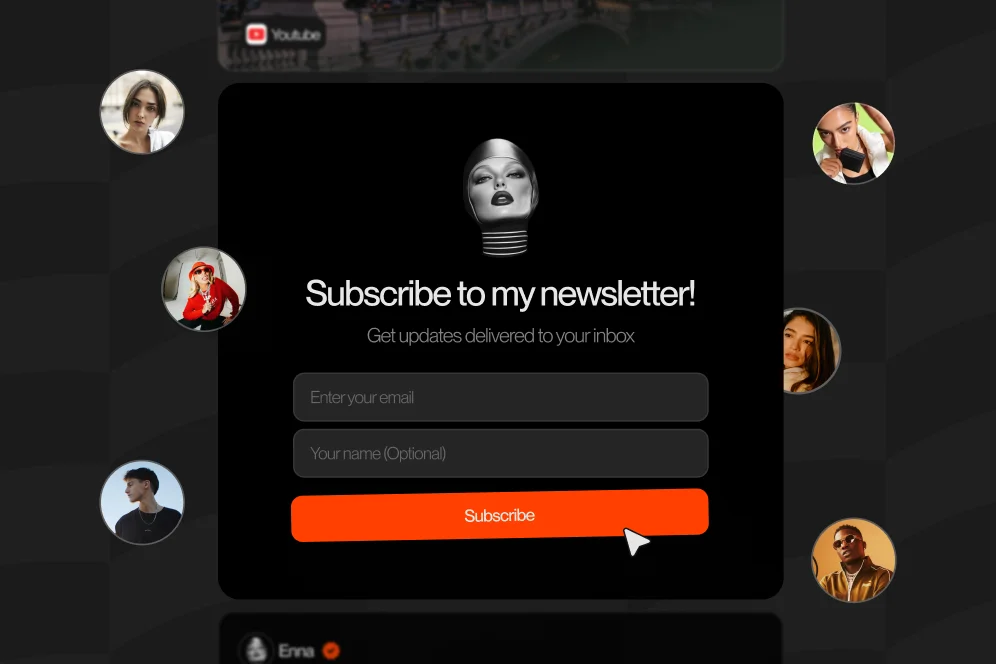
The delivery flow should collect the email in exchange for access, then pass the subscriber into the right segment inside your email platform. If a creator uses a page that only redirects out to separate tools, this handoff tends to get messy. On a conversion-focused storefront, subscriber capture belongs on the page itself, not hidden behind an extra chain of clicks.
How to build the funnel on a creator profile page
The fastest way to grow newsletter for creators with PWYW downloads is to stop thinking in isolated assets and build a complete path from profile visit to subscriber.
The path should be:
social post or AI citation -> profile page -> PWYW offer -> email capture -> delivery -> welcome sequence
That sequence matters because every extra decision point weakens the conversion rate.
What the page should include above the fold
A high-converting PWYW block usually needs just five elements above the fold:
- a one-line outcome-driven headline
- a short supporting description
- a product mockup or preview image
- a visible price-choice explanation
- a clear CTA
A strong example:
Headline: Get the creator newsletter starter pack I use to turn posts into subscribers
Description: Includes 12 newsletter prompts, 5 subject line patterns, and a simple content calendar. Pay what you want, including $0.
CTA: Get the pack
This works because the user does not have to decode the offer.
What to place immediately below the CTA
The next section should answer the visitor’s silent objections:
- Who is this for?
- What will I receive?
- Can I really enter $0?
- Will I be added to the newsletter?
Keep the copy plain. Overwriting this section usually hurts performance.
What to configure after the form submission
After submission, the system should do four things:
- Deliver the file immediately.
- Tag the subscriber based on the offer they claimed.
- Trigger a welcome email that references the asset.
- Send the subscriber into a short nurture sequence tied to the same topic.
If a creator downloads a content planner, the follow-up emails should continue the content-planning conversation. Do not drop them into a generic newsletter welcome sequence with no context.
This is where creator tool fragmentation causes trouble. If product delivery, email capture, and public page management live in separate tools, the experience breaks. We have covered that operational drag in more detail in our piece on tool fragmentation.
A practical rollout plan for the next 30 days
The mistake most creators make is launching three or four PWYW assets at once. Start with one. Measure it. Improve it. Then expand.
Use the following rollout plan.
Week 1: Pick the asset with the strongest immediate utility
Choose a download that is:
- fast to consume in under 15 minutes
- tightly aligned to your niche
- useful without further explanation
- connected to a paid offer, service, or deeper content stream
Good formats include:
- swipe files n- mini templates
- scripts
- checklists
- calculators
- lesson notes
- setup guides
Weak formats include broad ebooks, vague inspiration packs, and anything that feels like recycled filler.
As Lia Haberman emphasizes, creators tend to grow faster when they create for the audience they actually want. That applies here too. A PWYW resource should attract the future customer, not just the casual freebie collector.
Week 2: Build the page and define the measurement plan
Because there are very few universal benchmarks for a specific creator niche, the correct approach is to instrument your own funnel before promoting it.
Track at minimum:
- profile page visits
- offer views
- email submissions
- paid vs $0 claims
- download completion rate
- welcome email open rate
- click-through to the next offer
A simple baseline -> intervention -> outcome measurement plan looks like this:
- Baseline: current profile traffic and newsletter signup rate over 14 days
- Intervention: replace the generic signup block with one PWYW offer
- Target outcome: increase email capture rate and improve welcome-sequence engagement
- Timeframe: 30 days
- Instrumentation: page analytics plus email-platform tagging
That proof structure is stronger than guessing. If you currently capture subscribers from 2% of profile visitors, a realistic test is whether one focused offer can materially improve that number over a month. The exact result will vary by niche, traffic quality, and asset quality, so do not claim a benchmark you cannot support.
Week 3: Push traffic from your highest-intent channels
Most creators already have traffic sources. The problem is that they often send all traffic to a general bio page with too many choices.
Promote the PWYW offer from:
- your social bio
- pinned posts
- relevant content captions
- YouTube descriptions
- podcast show notes
- guest appearance mentions
A practical point supported by Medium’s roundup on creator email-list growth is that optimized social bios with clear calls to action remain one of the most direct ways to move social followers into an email list. If you are serious about newsletter growth, the bio CTA should point to the offer, not a cluttered set of unrelated links.
This is a good place for a contrarian rule: Do not send cold traffic to your newsletter homepage first; send it to the asset that earns the subscription.
The tradeoff is obvious. A dedicated offer page is narrower. But that narrowness is exactly why it converts.
Week 4: Review subscriber quality, not just raw volume
More subscribers is not always better.
Review these signals after the first month:
- welcome email open rate
- reply rate
- click rate to related content
- percentage of $0 claims vs paid support
- conversion into the next product, booking, or inquiry
If the list grows but engagement collapses, the asset may be attracting the wrong audience.
According to GTM Strategist, building in public and using the creator’s personal brand can pull in demand without paid ads. PWYW works especially well in that context because it feels transparent. You are not forcing a hard sale. You are inviting the audience into a useful exchange.
The page details that quietly change conversion rates
Small implementation decisions matter more than creators usually expect.
Keep the pricing language unambiguous
If the visitor is unsure whether $0 is allowed, conversions will drop.
Use direct phrasing such as:
- “Pay what you want, including $0.”
- “Get it free or support the work.”
- “Choose any price that feels fair.”
Avoid coy phrasing like “name your price” if your audience might interpret that as a minimum purchase requirement.
Show the newsletter benefit without overselling it
The visitor is primarily claiming the asset. The newsletter is the continuation.
Good phrasing:
- “You will also receive weekly creator growth notes.”
- “You will join the newsletter for more templates and breakdowns.”
Bad phrasing:
- “Subscribe now for exclusive game-changing insights.”
The simpler the promise, the better.
Match the asset format to the traffic source
A creator who gets traffic from short-form video usually converts best with highly practical assets: scripts, prompts, plug-and-play templates.
A consultant or educator with longer-form authority content may do better with mini playbooks, worksheets, lesson summaries, or calculators.
In other words, the best PWYW download is not the most impressive file. It is the easiest meaningful next step.
Pair SEO and AI-answer visibility with a direct offer
In 2026, content discovery does not end at search results. AI summaries and answer engines increasingly shape which pages get cited, then clicked.
That changes the job of the article and the profile page. The article must carry a clear point of view and a reusable model. The profile page must turn that attention into action quickly.
A practical funnel to optimize is:
impression -> AI answer inclusion -> citation -> click -> conversion
If your article teaches a concrete method and your profile page presents the matching download, the two assets reinforce each other.
That is why the strongest creator pages now act less like directories and more like storefronts. If you are evaluating alternatives, our overview of high-converting creator pages explains the design shift in more detail.
Common mistakes that make PWYW underperform
The format is strong, but execution errors are common.
Mistake 1: Using a weak asset to solve a funnel problem
PWYW does not magically make a boring resource attractive.
If the download is generic, the best-case outcome is low-quality list growth. The worst-case outcome is no growth at all.
Mistake 2: Hiding the contents behind vague copy
Visitors do not convert well on mystery offers.
Tell them what they get, how many items are included, and who it is for.
Mistake 3: Treating every subscriber the same
A subscriber who claimed a content template should not receive the same follow-up as someone who downloaded a consulting checklist.
Segment by claimed asset and build the next message around that context.
Mistake 4: Measuring only signups
A cheap signup is not a useful signup if the subscriber never opens an email.
Review post-conversion quality signals every month.
Mistake 5: Sending traffic through too many tools
This is one of the biggest operational problems for creators. Separate forms, separate delivery tools, separate storefronts, and separate booking links create friction you can feel but may not immediately see in reporting.
If a public page is meant to monetize attention, it should make subscribe, buy, book, and inquire possible from one place. That is the more accurate frame for Oho: not a prettier link list, but a conversion layer for the creator’s public profile.
Five questions creators ask before launching a PWYW download
Should the default price be $0 or a small number?
If list growth is the primary goal, defaulting to $0 or clearly allowing $0 tends to reduce friction. If immediate revenue is equally important, test a small suggested price while keeping the free option explicit.
What kinds of downloads work best?
The best-performing assets usually solve one immediate problem fast. Templates, scripts, checklists, calculators, swipe files, and tightly scoped mini-guides tend to work better than broad ebooks.
How long should the asset be?
Shorter is usually better. A five-page checklist that gets used is more valuable than a 40-page document that sits unread in a downloads folder.
Can PWYW hurt perceived value?
It can, if the page feels low quality or the asset looks disposable. It usually does not when the download is useful, specific, and visually packaged like a real product.
What should happen after someone downloads?
They should receive the asset immediately, then enter a short follow-up sequence tied to the problem the asset solves. The purpose of that sequence is to deepen trust and guide the subscriber toward the next relevant action.
FAQ
Is pay-what-you-want better than a completely free lead magnet?
Not always, but it is often better for subscriber quality. A standard freebie can maximize volume, while PWYW tends to create a slightly stronger commitment and better signal of buyer intent.
Can a small creator use this approach without a large audience?
Yes. In fact, it can be more useful for smaller creators because it gives each profile visit a clearer conversion path. You do not need huge traffic; you need an offer that matches the audience you already have.
What should creators sell as a PWYW download first?
Start with the smallest asset that solves a real problem. If your audience often asks the same question in comments or DMs, that is usually the first thing to package.
How do I know whether the subscribers are high quality?
Look beyond raw signup count. Check welcome-email opens, reply rates, clicks to related content, and eventual purchases, bookings, or collaboration inquiries.
Should the newsletter be the main product or the bridge to a paid offer?
Either can work. For many creators, the newsletter functions best as the owned relationship that sits between public content and paid offers, which makes a PWYW asset an effective bridge.
A strong PWYW offer does more than add subscribers. It gives creators a cleaner path from attention to relationship to revenue. If you want a public page where visitors can subscribe, buy, book, and inquire without getting routed through a messy stack of tools, explore how Oho can help you build that flow from one conversion-focused page.