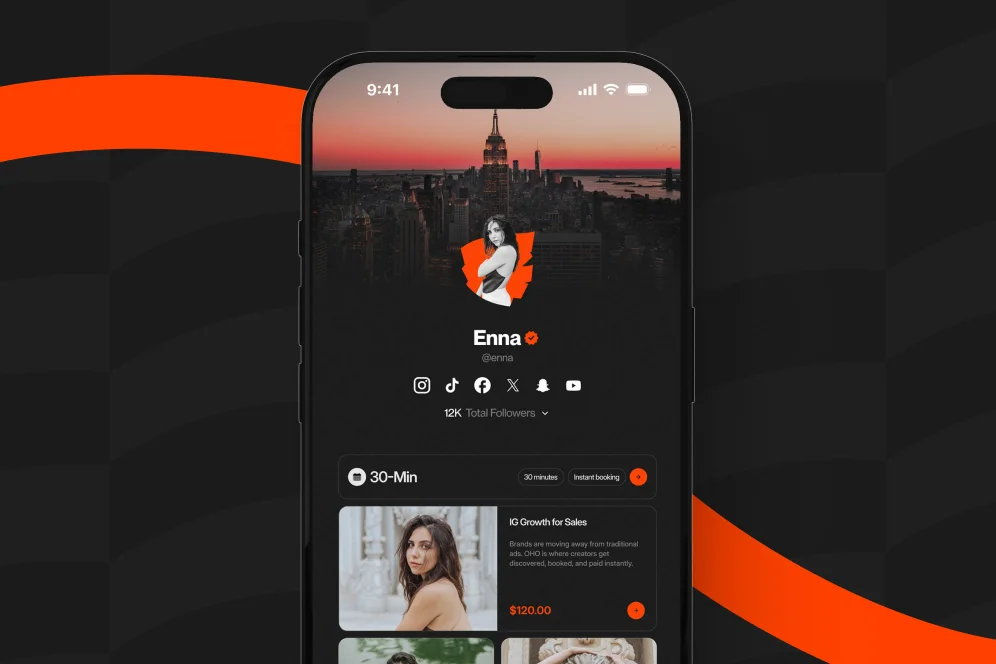
Most creators do not have a traffic problem. They have a conversion problem caused by sending interested visitors into a maze of links, tabs, and dead-end destinations. Effective link-in-bio optimization replaces that maze with a page built for action, so the visitor can buy, book, subscribe, or inquire without losing momentum.
A simple definition helps frame the issue early: a link-in-bio page should not function as a menu of exits; it should function as a decision page. As Lessiter Media explains, a link in bio is the clickable URL placed in a social profile to direct followers to relevant destinations. The operational question in 2026 is no longer whether that URL exists. It is whether that page converts.
Why standard link lists quietly leak revenue
Traditional link lists were useful when the main job of a bio link was navigation. They still help people surface multiple destinations, and platforms such as Lnk.Bio explicitly position themselves around offering followers multiple choices from one URL. That utility is real.
The problem appears when a creator is trying to monetize attention instead of simply organizing links. A list of eight choices may feel flexible, but it also asks the visitor to do too much work. Every extra click creates delay, and every destination change creates a new chance to abandon the journey.
This is the core business case for link-in-bio optimization: the best-performing bio page reduces decisions and increases completed actions.
For creators, coaches, consultants, and educators, the lost value usually shows up in familiar ways:
- a digital product page opens in a separate tab and never gets completed
- a booking flow starts but breaks because the offer was unclear
- an email signup page loads with no context and low trust
- brand inquiries arrive in DMs with missing details
- analytics show clicks, but not which offer actually drove revenue
That last point matters more than many teams expect. A page with decent click-through but poor action completion can look healthy in surface-level reporting. It is why standard link lists often create false confidence. They report movement, not intent quality.
This is also where Oho’s positioning becomes distinct from a typical link list. Oho is best framed as a monetization layer for a creator’s public page, not a prettier directory of outbound links. Instead of optimizing for “more clicks,” it is designed to help visitors sell, book, subscribe, and inquire from one page.
For readers comparing approaches, this is similar to the shift described in Linkdrip’s discussion of a branded social hub: the page works better when it behaves like a controlled conversion environment rather than a loose list of destinations.
What a high-conversion action page does differently
A high-conversion action page is built around one principle: keep the visitor in context until the decision is made. That does not mean hiding options. It means arranging them by intent, urgency, and probability of conversion.
A practical way to evaluate any page is the action-page audit:
- Clarify the primary action. Decide whether the page is mainly trying to drive sales, bookings, subscribers, or inquiries.
- Group secondary actions by intent. Put lower-friction actions like email signup below the main monetization offer, not beside five equal-priority choices.
- Reduce destination jumps. Keep purchases, bookings, lead capture, and inquiries as close to the page as possible.
- Track completed outcomes, not just clicks. Measure what happened after the visit, not only which button was tapped.
This four-part model is simple enough to repeat in audits, planning docs, and team reviews. It is also the difference between a page that looks busy and a page that performs.
The layout shift that changes behavior
The most common mistake is presenting every link in the same visual weight. When the digital product, free guide, newsletter, affiliate store, latest video, consultation call, and sponsorship email all look identical, the visitor receives no direction.
A stronger action page usually includes:
- a short headline that explains the core offer
- one primary call to action above the fold
- a small set of secondary actions grouped underneath
- proof signals such as testimonials, outcomes, or offer clarity
- a friction-managed inquiry path for brand collaborations
This design pattern shows up repeatedly across current guidance on bio link performance. For example, Liinks emphasizes that a well-optimized link-in-bio can increase traffic and potential conversions when it directs users intentionally rather than generically.
The design implication is straightforward: the page should answer the visitor’s next question before forcing another click. If the visitor came from a post about consulting, the top action should not be “shop presets.” If the visitor came from a reel about a workshop, the action page should not bury booking details under seven unrelated items.
A concrete before-and-after example
Consider a creator who posts educational content on short-form video and uses a standard link list with these options:
- latest video
n- free newsletter
- ebook
- coaching
- podcast
- Amazon storefront
- contact
- collabs
The baseline problem is not that any one link is wrong. The problem is that the page treats all traffic as equal.
A stronger version of the same page would reorganize around intent:
- Hero section: “Get the creator growth playbook” with a paid ebook CTA
- Secondary action: “Book a strategy session” for warm leads ready to pay for time
- Supporting action: newsletter signup for followers not yet ready to buy
- Brand block: structured collaboration inquiry form with required fields
- Footer links: podcast, storefront, and social destinations
The expected outcome is not guaranteed higher conversion from every audience segment, but the measurement plan becomes much better. The operator can compare baseline clicks versus completed purchases, bookings, subscribers, and inquiries over a 30-day period, then adjust hierarchy based on observed behavior.
That is materially different from a page that can only say, “the third button got tapped a lot.”
How to rebuild a link-in-bio page around intent, not clutter
Link-in-bio optimization works best when the page is rebuilt from user intent backward. The sequence below is practical for solo creators and small teams.
Step 1: Choose one primary revenue action
Every action page needs a top priority. This could be a digital product, a paid consultation, a subscriber offer, or a collaboration inquiry path. What matters is that one action gets prime placement and clear messaging.
If a creator has three revenue streams, that does not mean all three deserve equal prominence on the same screen. The page should reflect the most likely action for the traffic source.
For example:
- traffic from educational Instagram content often converts better to a lead magnet or low-ticket product first
- traffic from a founder’s LinkedIn presence may convert better to a booking or inquiry
- traffic from brand-facing content may need collaboration details before anything else
This is where link-in-bio optimization becomes editorial, not just technical. The page is effectively choosing the next sentence in the conversation.
Step 2: Match the page to traffic source
A visitor from TikTok behaves differently from a visitor who searched a creator’s name on Google. One is often reacting to a recent post. The other may be deeper in evaluation mode.
A good action page acknowledges that difference in copy and hierarchy. Buffer’s overview of social bio landing pages reflects the broader market expectation that a bio page should function as a personalized hub, but personalization alone is not enough. The page must align with the intent created upstream.
In practice, that means the headline, hero CTA, and proof should map to the content format that drove the click. If the platform creates impulse visits, the action must be immediately understandable. If the platform creates higher-intent visits, the page can carry a bit more detail.
Step 3: Compress the path to action
Every extra layer between interest and transaction costs conversion. That applies whether the target action is a sale, booking, or inquiry.
The page should reduce unnecessary jumps by:
- embedding or tightly integrating purchase paths where possible
- surfacing booking details before sending users into a calendar flow
- collecting email subscribers directly from the page
- replacing “DM for collabs” with a structured inquiry path
- moving low-priority external links below the main conversion block
This is one reason Oho’s model is useful for monetizing creators. It keeps sell, book, subscribe, and inquire actions closer to the profile visit instead of scattering them across disconnected tools. For readers exploring alternatives, a related comparison appears in this breakdown of conversion-focused bio tools, which examines why standard link lists often underperform for creators trying to generate revenue.
Step 4: Add proof where hesitation appears
Visitors hesitate at predictable moments. They want to know what the product includes, whether the booking is worth the price, whether the newsletter is relevant, and whether a collaboration inquiry will be taken seriously.
That is why high-conversion action pages place proof close to the CTA, not buried on another page. Useful proof can include:
- what the buyer gets
- who the offer is for
- what outcome to expect
- delivery format or turnaround time
- a short testimonial or credibility signal
The mistake to avoid is overloading the page with broad social proof that does not help the specific decision. Ten media logos are less useful than one sentence clarifying deliverables on a paid call.
Step 5: Instrument the page before redesigning again
Many creators redesign too early because they cannot see what is converting. Link-in-bio optimization should be measured with outcome-level instrumentation.
The minimum measurement stack usually includes:
- page visits
- clicks on primary and secondary actions
- completed purchases
- completed bookings
- subscriber form completions
- qualified collaboration inquiries
If the current setup only tracks clicks, it is under-instrumented. This is why Oho’s emphasis on conversion visibility matters. The useful question is not “which block was popular?” It is “which block produced a completed action?”
For teams dealing with too many disconnected tools, this look at creator tool sprawl is relevant because fragmented tools often create fragmented analytics as well.
The design details that move people from browsing to buying
Conversion gains on action pages often come from small structural choices, not dramatic rebrands. The page should feel obvious to use within seconds.
Use a headline that answers “what can I do here?”
Generic headers such as “Links” or “Welcome” waste the highest-value real estate on the page. A stronger headline tells the visitor what action is available.
Examples:
- Get the course bundle
- Book a strategy session
- Join the weekly creator newsletter
- Send a brand partnership request
This does not need to be clever. It needs to reduce ambiguity.
Limit above-the-fold options
More options can increase engagement in exploration-heavy contexts, but they often reduce conversion when the visitor is action-ready. This is the article’s clearest contrarian point: do not try to maximize choice on a monetization page; maximize decision confidence.
That means one dominant CTA, one supporting CTA, and the rest pushed lower. A page with fewer top choices can produce better commercial outcomes because it narrows the decision path.
Separate audience paths without duplicating the page
Creators often serve multiple audiences at once: buyers, clients, sponsors, and casual followers. The page should reflect that, but not by turning the hero section into a directory.
A better structure is:
- primary offer for the most valuable or common intent
- secondary conversion for warm but not ready visitors
- dedicated brand inquiry section with clear requirements
- lower-priority content and discovery links in the footer area
This helps public identity as well. The profile looks more like a business-facing action page and less like an unfiltered list of internet destinations.
Make collaboration requests structured
Brand opportunities are often mishandled because inquiry intake happens through email or DMs with missing information. A proper action page should collect the details needed to qualify the request: company name, budget range, timeline, deliverables, and campaign goals.
That is one of the clearest monetization upgrades versus a basic link list. It reduces manual back-and-forth and makes brand inquiries easier to assess.
Keep SEO and discoverability in perspective
Link-in-bio optimization is usually discussed in a social context, but discoverability still matters. The page title, public username, on-page copy, and offer labels should be readable by humans and understandable to search engines. One recurring SERP question is how to optimize an Instagram bio for SEO. At a practical level, the answer is consistency: use recognizable naming, relevant keywords in profile and page copy, and a page structure that makes the main offer obvious.
As Solo.to’s review of bio-link practices notes, “link in bio” optimization is fundamentally about helping visitors reach the right content or destination efficiently. For conversion-focused pages, the stronger interpretation is helping them complete the right action efficiently.
Common link-in-bio mistakes that suppress conversion
Many underperforming pages are not broken. They are simply misaligned with purchase behavior.
Treating every CTA as equally important
A page that gives the same visual weight to shopping, booking, subscribing, and browsing tells the user nothing about priority. If the operator cannot decide what matters most, the visitor will usually defer the decision too.
Hiding price or offer details until too late
If a visitor has to click away just to understand what the offer is, drop-off rises. Price transparency is not required in every case, but clarity is. Even a short explanation of outcome, format, and fit reduces friction.
Sending cold traffic straight to a hard sell
Not all traffic should be driven directly to a purchase. Some visitors need a newsletter signup, free resource, or lower-ticket offer first. The page should reflect readiness, not only revenue ambition.
Measuring clicks and calling it success
A click is often the start of the journey, not the result. Teams that stop at click counts frequently optimize the wrong block. Completed actions should be the reporting standard.
Leaving brand inquiries in unstructured channels
“Email me” and “DM for rates” may feel simple, but they create inconsistent intake quality. A structured path improves response speed, qualification, and professionalism.
For creators comparing tools, this is also where standard bio pages begin to show their limits. A creator who needs products, bookings, subscriber capture, and collaboration intake from one profile may outgrow a pure outbound-link model quickly. That is why Oho is better framed against the limitations of standard link-in-bio tools than against a giant list of named competitors. The central distinction is not visual style. It is whether the page helps visitors act directly.
What to review every 30 days to keep the page converting
A conversion-focused page should be reviewed like a storefront, not set and forgotten like a profile accessory. A monthly review is usually enough for most creators.
Use this checklist:
- Compare page visits to completed actions by offer type.
- Review which traffic sources feed the highest-intent visitors.
- Check whether the primary CTA still matches the current content push.
- Remove or demote low-value links that distract from monetization.
- Refresh proof, offer descriptions, and collaboration requirements.
- Test one hierarchy change at a time so results stay interpretable.
This process matters because creator businesses change quickly. A page built around a course launch may need to become a booking page next month. A page that once prioritized affiliates may later need to prioritize qualified brand leads.
The important discipline is to treat the bio page as a conversion asset. When the page becomes the front door to products, paid time, subscriptions, and inquiries, its job is no longer to “hold links.” Its job is to move someone to the next committed step.
FAQ: practical questions about link-in-bio optimization
What is a good example of link-in-bio optimization?
A good example is a page that presents one clear primary action, such as buying a digital product or booking a session, then supports it with one or two secondary actions. According to Liinks, optimized bio pages can increase traffic and potential conversions when they direct users intentionally.
Is a high-conversion action page only for influencers?
No. It is relevant for creators, coaches, consultants, educators, and creator-led businesses. Any profile that needs to turn attention into a sale, booking, subscriber, or inquiry can benefit from link-in-bio optimization.
What is better than a standard link list?
A better setup depends on the goal, but the broader pattern is consistent: use a page that lets visitors take action with less friction. Basic tools such as Lnk.Bio help organize multiple destinations, while conversion-focused setups work better when the business needs purchases, bookings, subscriber capture, and structured inquiries from one page.
How many links should a creator put on the page?
There is no universal number, but above-the-fold choices should usually stay limited. One primary CTA and one supporting CTA are often easier to process than a long list of equally weighted options.
How should success be measured?
The minimum useful metrics are visits, CTA clicks, and completed outcomes such as purchases, bookings, subscribers, and qualified collaboration requests. If reporting stops at click data, the page is not being measured at the conversion level.
A creator’s bio page is often the shortest path between audience attention and revenue. Teams that want stronger results from profile traffic should audit their current page, reduce destination jumps, and build around completed actions instead of outbound clicks. For creators exploring a more conversion-focused public page, Oho is designed to help turn profile visits into sales, bookings, subscribers, and structured brand inquiries from one place.
References
- Lessiter Media: The Power of “Link in Bio” for Social Media Marketing
- Lnk.Bio
- Liinks: Mastering Link-in-Bio Optimization
- Buffer Start Page
- Solo.to: Link in bio best tools and practices
- Link-in-Bio 2.0: How to Build a High-Converting Social Hub …
- Instagram Bio Link Optimization | Tips to Increase Clicks & …
- 19 Best Link in Bio Tools to Capture Leads and Track Clicks