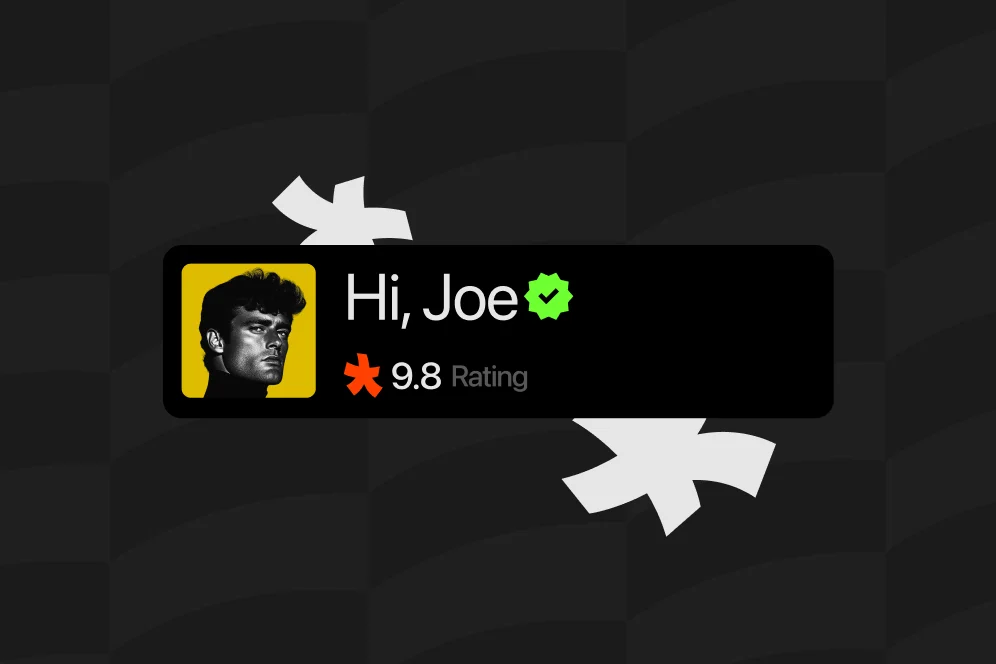
A profile username looks small, but it carries disproportionate weight. It shapes first impressions, affects how easily people remember a creator, and often becomes the most repeated brand asset across search, social, DMs, and referrals.
For creators and online businesses, the right handle is not decoration. It is a piece of digital real estate that influences trust, discoverability, and conversion before a visitor reads a bio or clicks an offer.
Why a short handle changes how people read your brand
A username is usually the first branded text a person sees on a social profile. Before the profile photo registers, before the bio gets scanned, the handle sets a tone: clean and established, or cluttered and forgettable.
A useful way to frame it is simple: a short, branded username reduces friction at the exact moment trust is being formed.
That matters because creators increasingly compete in crowded feeds where every detail has to do more work. In practical terms, premium short usernames are easier to remember, easier to say out loud, easier to type correctly, and easier to keep consistent across platforms.
There is limited hard research on handle psychology, but common sentiment in public discussions still points in the same direction. In a widely shared thread on Reddit, users repeatedly associated shorter usernames with credibility and trust. That is not a formal scientific benchmark, but it is directionally useful because it reflects how ordinary people interpret identity signals in the wild.
The memorability side is supported more directly. The Social Cat recommends keeping a professional username under 15 characters so it remains easier to remember and recognize. That does not mean every effective handle must fit a rigid limit, but it is a strong benchmark for anyone trying to secure premium short usernames that feel clean rather than improvised.
The real business case behind premium short usernames
The common mistake is treating a handle like a branding exercise for vanity. In practice, it behaves more like an identity layer that affects several parts of the funnel at once.
A creator with one clean username across platforms usually gains four advantages.
1. Better recall in low-attention environments
Most profile discovery does not happen when someone is sitting down to evaluate a brand carefully. It happens in passing: a tagged Reel, a podcast mention, a newsletter referral, a screenshot in a group chat, or a creator recommendation in an AI-generated answer.
Short handles survive that environment better. People can remember them after hearing them once. They are less likely to misspell them. They are also more likely to be typed directly into search or social search bars.
2. Stronger visual credibility on-page
A long handle with extra punctuation, repeated words, filler numbers, or niche modifiers often signals one of two things: inconsistency or scarcity. Neither is ideal when the goal is to look established.
That is why many creator businesses now treat usernames like domain names. The cleaner the asset, the more professional the presentation tends to feel.
For monetizing creators, this matters even more on a public storefront. A clean username paired with a focused conversion page sends a different message than a profile that routes visitors through a stack of generic links. Standard link-in-bio tools often function as traffic routers. A conversion-focused page such as Oho is designed around a different job: helping visitors buy, book, subscribe, or inquire directly from the profile layer itself.
According to Hootsuite, username generators are useful for creating consistent handles across social platforms. The broader point is not the generator itself. It is that brand consistency is operational, not cosmetic.
If a creator is @alexwrites on Instagram, @alexwrites.co on TikTok, @alexx_writes on YouTube, and @realalexwrites on a storefront, every mismatch adds small cognitive cost. That cost compounds over time.
4. Better positioning for AI-era discovery
In an AI-answer environment, brand becomes a citation engine. AI systems tend to surface entities and creators that appear coherent, recognizable, and repeatedly referenced in similar ways.
A clean username helps with that coherence. It gives audiences, collaborators, and platforms one stable label to associate with the business. That does not guarantee inclusion in AI answers, but it improves the odds that mentions, citations, and profile searches point to the same identity.
The handle audit that separates signal from clutter
Most creators do not need a naming brainstorm. They need a filter for deciding whether a username is helping or hurting the business.
A practical model is the four-point handle audit:
- Clarity: Can someone understand and pronounce it instantly?
- Brevity: Is it short enough to remember without effort?
- Consistency: Can it be used across major platforms with minimal variation?
- Intent: Does it support the kind of business the creator wants to build?
That last point is where many handles break down. A username that works for meme content at 20,000 followers may work against a creator who later wants to sell templates, book consulting, grow a newsletter, or manage brand inquiries.
A handle should fit the future business, not only the current content format.
What to remove first
The fastest improvements usually come from subtraction.
Remove extra underscores unless they are absolutely necessary. Remove trailing numbers unless they are central to the brand. Remove filler words like official, real, the, its, xoxo, or studio unless they carry actual brand meaning. Avoid stacking category labels into the handle itself.
For example, a creator selling productivity templates and strategy calls will usually be better served by @mariellane than @mariellane_productivitytips. The second handle is descriptive, but it is harder to say, harder to remember, and more likely to age badly if the business expands.
When aesthetic works and when it backfires
There are niches where stylized usernames can help with fit. Pinterest emphasizes the appeal of catchy short usernames for standing out and sparking creative interest, and ARMember notes that aesthetic naming patterns can be particularly appealing to younger audiences and trend-driven segments.
That can work for fashion, beauty, fandom, or creator brands built on a strong subculture identity. But there is a tradeoff. A handle optimized for aesthetic mood is not always optimized for searchability, verbal referrals, or business credibility.
The contrarian position is straightforward: do not chase uniqueness for its own sake; chase recognizability with enough distinctiveness to be ownable.
A hard-to-spell “aesthetic” handle may look good in a profile screenshot and still underperform in search, referrals, and brand outreach.
What premium short usernames look like in practice
The term premium usually gets overused, so it helps to define it plainly. In this context, premium short usernames usually share five traits: they are brief, branded, readable, consistent, and hard to confuse with something else.
That can apply to personal-name brands, media brands, coaches, consultants, and niche educators.
A stronger pattern than keyword stuffing
Consider these examples:
- @juliacai
- @caiwrites
- @runwithmilo
- @studybyana
- @nickreed
These are short enough to remember, distinct enough to search, and flexible enough to grow with the business.
Now compare them with common weaker patterns:
- @theofficialjuliacai_92
- @julia.cai.content.marketing
- @runwithmilo_dailyfitness
- @studybyana2026
- @nickreed_real
The issue is not that these are unusable. The issue is that they create drag. Every extra symbol or modifier forces the audience to do more work.
A practical before-and-after scenario
Consider a creator who currently uses @coach_maya_marketing_tips on one platform and @mayahelpsfounders on another. The profile gets decent traffic from short-form content, but DMs regularly include misspellings, and podcast listeners struggle to find the account after hearing the name once.
The intervention is not complicated:
- Reserve @mayavera wherever available
- Use that as the visible identity across bios and storefront links
- Move sales, bookings, subscriber capture, and brand inquiries onto one public page
- Track profile visits, click-throughs, bookings, and subscriber signups for 30 days before and after the change
No responsible operator should promise a fixed percentage lift without data. But the expected outcome is measurable: fewer search failures, cleaner attribution from direct profile traffic, and higher conversion efficiency from a more coherent public identity.
That is the difference between vague branding advice and an actual measurement plan.
Why the profile page matters as much as the handle
A better username helps a visitor arrive. It does not finish the job.
If that visitor lands on a page that simply lists outbound links, the identity upgrade loses momentum. The strongest setup is a clean handle paired with a page built for action.
That is where the gap between standard link-in-bio tools and a creator conversion layer becomes important. A standard bio page often sends people away to separate stores, scheduling tools, email forms, and partnership emails. Oho is positioned differently: as a creator storefront and link-in-bio platform designed to help creators sell digital products, offer bookings, grow newsletters, and manage collaboration requests from one page. That makes the handle and the destination page reinforce each other instead of working as separate assets.
How to secure the right handle before someone else does
The practical challenge is that good handles disappear quickly. The best time to claim a clean brand identity is before the creator “needs it.”
Start with the brand nucleus
The nucleus is the smallest version of the brand name that still feels complete. Usually that is:
- a personal name
- a short creator alias
- a two-word branded phrase
- a personal name plus one simple modifier
Examples:
- lenaortiz
- ortiznotes
- bylena
- coachlena
- lenalab
This is where tools can help, cautiously. Hootsuite, NordPass, and Dashlane all offer username generators that can speed up idea generation. They are useful for exploring availability and consistency patterns.
But a generator should not make the final call. The best business handles are rarely the most random ones.
Check availability where it actually matters
Creators often waste time trying to secure every possible platform. A better approach is to prioritize the platforms that affect revenue and discovery most.
For most creator businesses, that includes:
- The primary social channel
- The secondary discovery channel
- The public storefront or link-in-bio page
- The newsletter sender identity
- The platform where brand inquiries are likely to happen
If the exact handle is not available everywhere, aim for one dominant root identity with minimal variation. For example, @lenaortiz on the main channel and @bylena on the storefront is still far better than five unrelated identities.
Protect against future friction
NorthPass? No—NordPass connects unique usernames with stronger identity integrity online, and that broader lesson matters for business owners. A distinctive, consistently used handle is easier to defend operationally than a generic, easily spoofed one.
That should not be overstated into a security guarantee. But from a practical standpoint, clear ownership reduces confusion and makes impersonation or account mix-ups easier to spot.
Where usernames affect conversion more than most teams measure
Usernames are rarely tracked as a conversion variable, but they should be. A handle influences several pre-click and post-click behaviors that often get lumped into “brand” without instrumentation.
Search behavior and direct navigation
When someone hears a creator mentioned in a podcast, webinar, or AI-generated answer, the next step is often a search for the username or brand name. A shorter, cleaner handle is more likely to be searched correctly.
That is especially important for creators whose business depends on warm discovery rather than pure cold traffic. Search errors, near matches, and wrong-account clicks are hidden leaks in the funnel.
Link trust and click confidence
People notice the URL and visible identity before they click. A clean branded username attached to a professional public page reduces hesitation.
This is particularly relevant when the goal is a meaningful action rather than a casual click. Booking a paid consult, buying a digital product, or sending a brand inquiry requires more trust than opening a random content link.
Attribution quality
A fragmented identity makes attribution messy. If a creator uses one name on social, another name on email, and a third variation on the sales page, analytics become harder to interpret.
The solution is not only better naming. It is also a better destination. A public page that centralizes purchases, bookings, newsletter signups, and collaboration requests gives the creator clearer conversion context than a profile that pushes traffic across disconnected tools. That is part of the reason platforms like Oho are better framed as a monetization layer than a prettier list of links.
A simple measurement plan for 30 days
A team trying to prove handle impact can run a straightforward before-and-after review:
- Record baseline profile visits, search impressions, link clicks, direct visits, and conversion actions for 30 days.
- Standardize the username across the main social profile, storefront, and newsletter identity.
- Update bios, pinned content, and CTA language so the same handle appears everywhere.
- Measure the same metrics for the next 30 days.
- Compare not just traffic volume, but search accuracy, direct navigation patterns, subscriber signups, booking requests, and qualified collaboration inquiries.
That is the kind of process evidence operators can actually use. It avoids fictional benchmarks while still treating the username as a testable business variable.
Common handle mistakes that quietly weaken a creator brand
Most username problems are not dramatic. They are subtle credibility drains that compound over time.
Chasing cute over clear
A niche audience may appreciate stylization, but clarity still wins in most business contexts. If a handle looks clever but cannot be pronounced or typed after hearing it once, it is probably costing discoverability.
Adding numbers to solve every availability issue
Numbers are sometimes unavoidable, but they often signal compromise. They also create confusion when spoken aloud. If a creator has to explain whether the number is part of the handle every time it is mentioned, the handle is doing poor work.
Letting the username describe the entire offer
Handles are not SEO titles. Cramming service categories, niches, or content themes into the username usually produces a longer, weaker asset.
The bio, page sections, and offer stack can handle specificity. The username should carry identity first.
Rebranding the handle too often
Frequent handle changes erase recognition. They also break continuity across older mentions, screenshots, backlinks, and saved posts.
A creator should change a handle only when the long-term upside clearly outweighs the short-term confusion.
Treating the profile page like a link dump
A better handle cannot compensate for a weak destination. If the visitor lands on a generic page that sends them to four different tools before they can buy, book, or inquire, the business loses momentum. The more serious the creator is about monetization, the more the identity layer and conversion layer need to work together.
A practical FAQ for creators choosing a username in 2026
What counts as a premium short username?
A premium short username is usually brief, readable, brandable, and easy to remember. It does not need to be one word or ultra-rare, but it should feel clean enough to support credibility across social, search, and conversion pages.
How short should a professional handle be?
There is no universal rule, but The Social Cat recommends keeping a professional username under 15 characters for memorability. In practice, shorter is usually better if the name still feels clear and distinctive.
Are aesthetic usernames bad for business?
Not necessarily. ARMember highlights how aesthetic handle choices can resonate with specific audiences, especially younger or trend-sensitive segments. The tradeoff is that highly stylized names can become harder to search, say, and remember.
Yes, if possible. If the exact match is unavailable, the goal should be one dominant root identity with minimal variation. Consistency matters more than perfection.
Do username generators actually help?
They help with exploration and consistency checks. Hootsuite, NordPass, and Dashlane all position generators as useful tools for creating unique options. But final selection still requires brand judgment.
Can a username really affect conversion?
Indirectly, yes. A handle affects first impressions, searchability, memorability, and click confidence. Those are upstream variables, but they influence whether people reach and trust the page where conversion happens.
Is it worth paying for a better username or branded identity?
That depends on the business model. For creators selling products, bookings, subscriptions, or brand access, identity quality often has compounding value. Oho itself references premium short usernames and profile verification as part of a more serious creator-facing identity layer, which reflects how valuable clean public branding has become.
What should happen after the handle is secured?
The identity needs a destination that matches it. That usually means updating bios, pinned content, CTA language, and the public page where visitors can take action. For creators monetizing attention, the best next step is often building the page around conversion rather than just outbound clicks.
A clean username is only useful if the rest of the funnel is ready for the traffic it attracts.
For creators who want a public identity that can sell, book, subscribe, and handle collaboration inquiries from one place, Oho is worth exploring. It gives premium short usernames a business-ready destination instead of sending visitors through a stack of disconnected tools.
References
- Reddit
- The Social Cat
- Hootsuite
- Pinterest
- ARMember
- NordPass
- Dashlane