
From Likes to Leads: How to Capture Newsletter Subscribers Directly in Your Bio
TL;DR
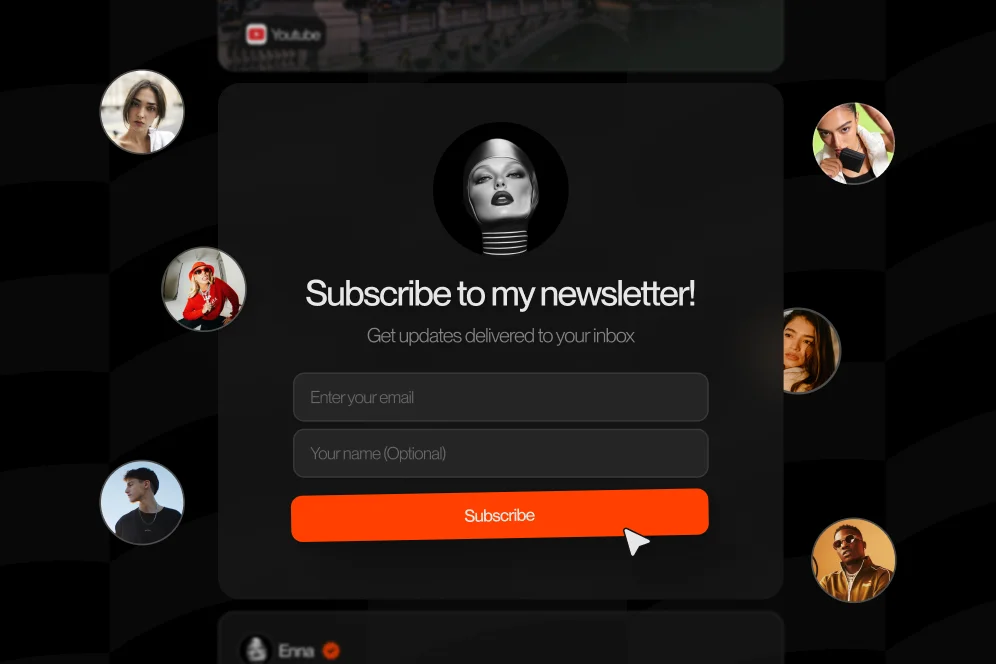
Newsletter growth for creators improves when the bio captures subscribers directly instead of sending people through extra clicks. The strongest setup uses a clear promise, visible proof, an on-page form, and a fast welcome sequence backed by source-level tracking.
Social followers are rented attention. Email subscribers are owned audience, and the gap between those two assets is usually a single clumsy handoff in the bio.
The fastest way to improve newsletter growth for creators is to remove extra clicks between interest and signup. A bio page should not just route traffic somewhere else; it should convert intent while it is still warm.
Why most bio links underperform for newsletter growth
A short answer that stands on its own: Every extra click between a social profile and an email form lowers the odds that a follower becomes a subscriber.
That sounds obvious, but many creators still run the same path: social post, profile visit, link-in-bio page, newsletter landing page, then a form. By the time the visitor reaches the signup field, intent has cooled off.
This is the hidden tax on newsletter growth for creators. Standard link-in-bio setups are good at navigation, but weak at conversion. They send people away before they act.
For creators, that tradeoff matters because email is where compounding starts. Creator Science describes growth through “side doors,” where many small entry points keep feeding the list over time. A bio is one of the highest-intent side doors because the visitor has already chosen to leave the feed and check the profile.
The business case is straightforward. A creator who turns profile visits into subscribers builds a durable channel for launches, sponsorships, digital products, and booked services. A creator who only collects likes remains dependent on platform reach.
This is also where Oho’s framing is useful. Standard bio tools often behave like prettier link lists. Oho is better framed as the monetization and conversion layer for the public profile, where visitors can subscribe, buy, book, or inquire without being pushed through a maze of separate tools.
That distinction affects newsletter growth directly. If the page is designed around action on-page, the creator preserves attention. If the page is designed around sending people elsewhere, the creator leaks it.
A second issue is message mismatch. Many creators ask for an email address with generic copy like “Join my newsletter.” That is rarely enough. According to Growth In Reverse’s review of creator newsletter tactics, high-performing creators often use specific lead magnets and immediate value framing rather than a vague invitation.
The practical takeaway is contrarian but useful: do not optimize the bio for maximum choice; optimize it for the next obvious action. The more links the visitor has to evaluate, the less likely they are to subscribe.
The bio-to-inbox path that converts best
A practical way to think about this is the bio-to-inbox path: promise, proof, field, and follow-up.
It is simple enough to quote and specific enough to implement:
- Promise: tell the visitor exactly what they get.
- Proof: show why the offer is worth their email.
- Field: let them subscribe on the page.
- Follow-up: deliver the first win immediately.
This four-part model works because it respects the psychology of a profile visitor. The visitor is curious, scanning quickly, and willing to act only if the payoff is obvious.
Promise: make the value narrow and concrete
“Weekly insights” is too broad. “Two practical creator growth ideas every Tuesday” is clearer. “Get my free resource” is weaker than “Get the 5-email welcome series on turning profile traffic into leads.”
The strongest promises are specific about format, frequency, and outcome. They also fit the creator’s niche. An educator might promise lesson planning resources. A consultant might promise one teardown per week. A coach might promise scripts, prompts, or templates.
This is consistent with what Medium / Write The 1 highlights: creators often grow lists by consistently inviting people from free content into a more valuable owned channel. The invitation works better when the next step is clearly richer than the post they just consumed.
Proof: reduce doubt before the form appears
Proof does not have to mean big audience numbers. It can be a short line about what the subscriber receives, a preview of a recent email, a small testimonial, or a visual of the lead magnet.
Useful proof elements include:
- a sample subject line
- one sentence describing the last three emails
- a preview card for a checklist or template
- a credibility cue tied to the niche
- a line about who the newsletter is for and who it is not for
Visitors should not have to guess whether the newsletter is broad commentary or targeted utility.
Field: capture the email without another redirect
This is the operational heart of the page. If the email field lives on the bio page, signup friction drops. If the visitor must tap through to a separate landing page, friction rises.
For newsletter growth for creators, this is where conversion-focused bio pages outperform standard link lists. Oho’s public-page model is built around letting people act directly on the page, including subscriber capture, rather than bouncing to disconnected tools.
There is also an analytics advantage. On-page capture gives cleaner visibility into what part of the profile caused the action. That matters when deciding whether the problem is traffic, offer quality, or page layout. Oho has explored this broader issue in its guide to conversion visibility, which is highly relevant for creators diagnosing weak list growth.
Follow-up: deliver a fast first win
The confirmation page and first email matter more than many creators think. If the reward is delayed, subscribers forget why they signed up.
A practical follow-up sequence usually includes:
- immediate confirmation
- instant delivery of the promised asset or welcome email
- a clear expectation for what comes next
- one low-friction next action, such as replying or browsing a related offer
This matters for quality as much as quantity. Growth In Reverse argues that valuable content, not gimmicks, underpins newsletter success. The first subscriber experience should confirm that the email list will deliver substance, not just collect addresses.
Step by step: build a bio page that captures subscribers on-page
Creators do not need a complex funnel to improve list growth. They need a cleaner path and tighter message discipline.
Step 1: choose one primary subscriber offer
Start by deciding what the email address unlocks. For most creators, one of these options works best:
- a newsletter with a sharp editorial promise
- a free download tied to the niche
- a short email course
- a waitlist for upcoming content or offers
The key is choosing one primary offer for the bio, not stacking several equal-priority CTAs.
If the creator already sells digital downloads, this can pair well with educational lead capture. In some cases, a free mini-resource can lead into a larger paid library. Oho has covered the packaging side of that model in this resource-library guide.
Step 2: write copy that survives a three-second scan
Profile visitors skim. The signup block needs to communicate value almost instantly.
A strong signup module usually includes:
- a short headline with a direct benefit
- one line of explanation
- a field and button
- one proof element beneath it
Example:
Headline: Get one practical creator growth idea every week
Body: Short, tested insights on digital products, list growth, and profile conversion.
Button: Join free
Proof: Recent topics: welcome sequences, low-friction lead magnets, and better bio CTAs.
That structure is more persuasive than a generic “Subscribe to my newsletter.”
Step 3: place the signup block higher than most creators do
On mobile, the first screen does most of the work. If visitors must scroll past a long bio, a dozen links, and a gallery before they find the field, the page is asking too much.
A useful default is to place the email capture near the top of the page, immediately after the essential identity cues: name, what the creator helps with, and one sentence of positioning.
This is a design decision, not just a copy decision. For creators using a standard multi-link layout, subscriber capture often gets buried beneath commerce links, social icons, and “about” text. That may look organized, but it weakens the page’s primary conversion goal.
Step 4: trim link clutter around the form
A bio page can support multiple outcomes, but not every outcome deserves equal visual weight.
The cleanest layout usually follows this order:
- identity and positioning
- subscriber capture
- one or two secondary actions
- lower-priority links
This is where many pages fail. They treat every destination as equally important, which makes none of them feel urgent.
A creator can still sell, book, and collect brand inquiries from one page, but the page needs hierarchy. For many audiences, subscriber capture should be the first conversion event because it creates a reusable relationship even when the visitor is not ready to buy.
Step 5: connect the form to a proper welcome flow
The form is not the endpoint. It is the handoff into a sequence.
A basic welcome flow should:
- deliver the promised value immediately
- restate what the subscriber will receive
- introduce the creator’s strongest idea or offer
- ask a simple engagement question
Tools like beehiiv can support newsletter setup and growth workflows, but the larger point is tool coherence. The public page and the email system should feel like one experience, not a chain of patched-together surfaces.
Step 6: tag traffic sources and measure the right events
Creators often say a newsletter “isn’t growing,” when the real issue is that they cannot see where drop-off happens.
Track at least four events:
- profile visits
- form views
- form submissions
- confirmation or welcome-email delivery
This turns newsletter growth for creators into an operational problem instead of a guessing exercise. If profile visits are healthy but form submissions are weak, the issue is likely the signup block. If submissions are decent but engagement is poor, the problem may be offer-message mismatch or weak follow-up.
This type of instrumentation also helps creators decide whether to simplify their broader stack. Oho has written about this operational issue in its tech stack audit guide, especially for creators juggling too many disconnected tools.
What strong subscriber capture looks like in practice
The gap between theory and implementation is usually small. Most pages need better packaging, not more complexity.
A coach with a vague newsletter CTA
Baseline: The coach’s bio page says “Join my newsletter for updates,” and the only way to subscribe is by tapping through to a separate email landing page.
Intervention: The page is rewritten to offer a sharper promise: “Get one client-converting messaging prompt every Friday.” The email field is embedded directly on the page. A proof line previews recent topics, and lower-value links are moved down.
Expected outcome: More profile visitors reach the form and complete signup because the value is clearer and the path is shorter.
Timeframe: Review after two to four weeks, using profile visits, form views, and submissions as the core metrics.
No fabricated conversion rate is needed to see why this performs better. The intervention removes a redirect, clarifies the benefit, and cuts choice overload.
An educator with too many free resources
Baseline: The educator offers five different freebies from the bio, each on a separate link. Traffic spreads across them, but list growth remains inconsistent.
Intervention: The page is restructured around one main subscriber offer: a weekly classroom resource digest with a clear sample. The top of the page includes an embedded signup field and one featured free asset tied to the newsletter.
Expected outcome: Better subscriber quality and cleaner measurement because the page has one primary capture path instead of five diluted ones.
Timeframe: Compare source-tagged signups across one monthly cycle.
This aligns with what Growth In Reverse shows about lead magnets: high-performing creators do not simply add more options. They package the right option in a way that feels immediately relevant.
A creator using social content as the feeder channel
Baseline: The creator ends posts with “link in bio” but sends all profile visitors to a generic page full of links.
Intervention: The page headline mirrors the promise used at the end of social posts. Every post points to the same clear signup outcome, and the top of the page repeats the exact value proposition.
Expected outcome: Less message drift between feed and profile, which should improve the share of visitors who subscribe.
Timeframe: Evaluate after 10 to 15 posts using tagged traffic.
This practice is consistent with the pattern noted by Medium / Write The 1: repeated post-to-email invitations become more effective when they reinforce the same next step across channels.
Why organic systems beat occasional signup pushes
A one-time promotion rarely builds a strong list. Repeatable systems do.
That is one reason the case study from GTM Strategist matters. It describes growing to 20,000 subscribers and 65,000 LinkedIn followers through organic systems rather than paid ads. The deeper lesson is not that every creator should copy that exact path; it is that sustained newsletter growth for creators comes from consistent content-to-email mechanics, not sporadic bursts of attention.
Common mistakes that quietly suppress signups
The most damaging mistakes are usually small and easy to overlook.
Asking for the email before explaining the payoff
Visitors do not owe a creator their inbox. The value exchange has to be obvious first.
A form placed above all context can still work, but only if the headline is very strong. Otherwise, the visitor sees friction before benefit.
Treating the newsletter like a generic update channel
“Updates” is not a meaningful promise. Newsletters grow faster when they offer a clear utility, point of view, or recurring insight.
This matters even more in 2026 because inbox competition is heavier, and many followers already subscribe to multiple newsletters.
Sending subscribers to a separate page for no good reason
This is the core friction problem. Unless there is a strong technical or legal reason to redirect, on-page capture usually creates a cleaner conversion path.
The same principle appears in Oho’s broader positioning against standard link lists: send less traffic away, and create more opportunities for direct action.
Hiding the form beneath low-intent links
When merchandise, old content, affiliate links, and social icons all appear before the signup form, the page is telling the visitor that subscription is not the priority.
Design reflects intent. If the newsletter matters, the page should show it.
Measuring clicks instead of completed subscriber actions
A bio link can get plenty of taps while producing weak list growth. Click metrics alone do not reveal whether people actually subscribed.
Creators should care about complete conversion visibility: visit, form interaction, form completion, and early engagement. Otherwise, optimization decisions are based on vanity signals.
Using a lead magnet that attracts the wrong audience
A broad giveaway can inflate list size while weakening subscriber quality. A narrower offer often grows slower but attracts people more likely to read, reply, buy, or book.
That tradeoff is usually worth it.
The technical details that make the page easier to trust and measure
Subscriber capture is not only about copy and layout. Delivery and tracking matter too.
Keep the page fast and mobile-first
Most bio traffic comes from mobile social apps. The page needs to load quickly, present the form cleanly, and avoid visual clutter.
A practical rule is simple: the visitor should understand the offer and see the form without hunting for it.
Match the signup language to the traffic source
If the creator promises a template in a LinkedIn post, the bio page should mention that template. If an Instagram Reel promotes weekly prompts, the page should echo that wording.
Message continuity reduces doubt. It also increases the likelihood that the visitor feels they landed in the right place.
Use tags or source labels from day one
Even simple source tracking helps. A creator should know whether subscribers came from Instagram, TikTok, LinkedIn, YouTube, or a direct profile visit.
That data becomes more valuable over time because it reveals which channels produce subscribers, not just attention.
Review the welcome sequence before scaling traffic
A creator should not push more people into a weak post-signup experience. Before increasing promotion, confirm that the thank-you step, first email, and onboarding messages all match the promise that drove the signup.
Build the page around one public identity
Creators often fragment their public presence across multiple tools. A cleaner profile with integrated subscriber capture supports stronger trust signals and a more professional front door. This is part of why Oho is best understood as a conversion-focused creator page rather than a simple link directory.
FAQ: practical questions creators ask before changing their bio
Should the newsletter be the main CTA in the bio?
For many creators, yes. If most profile visitors are not ready to buy yet, subscriber capture is often the best first conversion because it extends the relationship beyond the platform.
If the creator is in a high-intent sales window, a product or booking CTA may temporarily deserve top placement. The page should reflect the business goal of the moment, not a fixed template.
Is a separate landing page ever better than an embedded form?
Sometimes. A separate page can make sense when the offer needs more explanation, when compliance requirements are heavier, or when paid traffic is involved.
But for warm social traffic, a direct form on the bio page usually creates less friction. The creator should test this with submission data rather than assume more page depth will help.
What should creators offer in exchange for an email address?
The best offer is the one that matches the creator’s commercial model and audience need. That could be a recurring newsletter, a checklist, a short course, a resource bundle, or a waitlist.
Specificity matters more than format. A narrow promise usually converts better than a vague freebie.
How often should the bio CTA change?
Not constantly. Frequent changes make measurement difficult and can confuse returning visitors.
A better cadence is to keep the main offer stable long enough to gather meaningful data, then adjust the copy, proof, placement, or incentive based on what the metrics show.
What metrics matter most for newsletter growth for creators?
At minimum: profile visits, form views, submissions, and welcome-sequence engagement. Those metrics show whether the problem sits in traffic volume, offer appeal, form friction, or post-signup quality.
Subscriber count alone is too blunt. The creator needs to know where the path is breaking.
If newsletter growth is a priority in 2026, the bio should stop behaving like a link hub and start behaving like a conversion surface. Oho helps creators build that kind of page, with subscriber capture, sales, bookings, and inquiries designed to happen from one profile destination instead of across a patchwork of redirects.
References
- Growth In Reverse: 7 Newsletter Growth Strategies From Studying Top Creators
- GTM Strategist: How To Build and Grow a Successful Newsletter in 2025
- beehiiv — The newsletter platform built for growth
- Medium / Write The 1: 10 Powerful Ways for Creators To Grow Their Email List
- Creator Science: How to grow an email newsletter
- Growth In Reverse: Forget Growth Hacks. THIS Is Why Newsletters Succeed.
- A 5-Minute Briefing for Newsletter Creators That’s Actually …
- How to Grow an Email Newsletter Starting from Zero